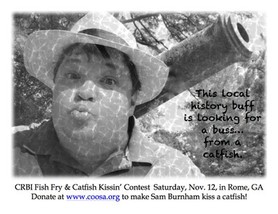
 In the previous post I mentioned an upcoming announcement. The cat is out of the bag on our social media sites but this is the official announcement on the blog.
I will be participating in this year's Coosa River Basin Initiative Catfish Kissing Contest. The contest is a fundraiser for CRBI, an advocacy group that is dedicated to the Coosa River Basin, which they tout as the most biologically diverse basin in North America. I'm definitely a supporter and admirer of wildlife and the unconquered spaces in our state but these rivers mean more to me than just that. And I think my perspective may be a bit different than many. I want to add the historic perspective into the conversation. These rivers are more than just waterways. They are the highways of our history. These were the transportation system of the Native American people groups who inhabited this area 100 years ago. These rivers carried the steamboats that shipped cotton and other goods to Mobile to be placed on ships headed to England or France. These are the rivers that our grandparents and great-grandparents fished and swam in. These are the rivers that armies crossed and recrossed in the desperate attempt to save or capture Atlanta, depending on which color their wool coat was. For over ten centuries these rivers have been life, transportation, jobs, livelihoods, and recreation for people living in this area. They have flooded our cities and taken the lives of our loved ones, causing for a contentious relationship at times but life would not be possible in this area without them. They have been abused by us over the years as well. But as we have learned more about them we have found ways to coexist and that is what we must continue to do. And so I throw my hat in this ring. The historian who knows that our future in inextricably tied to our past and our ability to learn from it is asking for your help. If that isn't enough to earn your donation, consider that the top donation recipient will stand in front of an audience and pucker up and kiss a squirmy, slick, whiskery old catfish! So, if you want to contribute to make that happen, go to the contest page and find my goofy face with the predictable cannon and go to the donate button below it. (Sorry, Confederate & Mississippian Native American currencies cannot be accepted at this time). Then if you want to witness this Catfish Kissin in person, buy your tickets on this site and join us on November 12th at Rome's First United Methodist Church in historic downtown and enjoy some fried fish and cheese grits for a good cause! See you there!
0 Comments
By Sam Burnham @C_SamBurnham 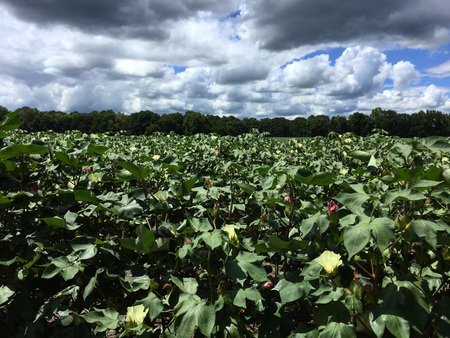 Georgia's Cotton Production is Perennially Near the Top in the Nation Georgia's Cotton Production is Perennially Near the Top in the Nation I talk about a lot about soil, nature, rivers, not the typical topics you tend to find from a more conservative writer. I wasn't always as interested in those things. Honestly, yes I was but I never really made them an issue because, as I just said, they're not the typical topics of a conservative. I grew up following Republican politics. I saw the economy as something that should take precedent over environmental causes. But a few things happened as I grew older. I remember riding past a local landfill with a mentor that I only refer to here as "The Sage". He pointed out the truck window at the treeline that hides the refuse from the paved road and said "I used to hunt all that property." Then I thought about that property being a big pile of garbage. More recently, my wife and I were driving down I-75 in Cobb County and saw the big concrete thing that is being built alongside the highway. Part exit ramp, part Lake Pontchartrain Causeway, all eyesore, I gazed upon it and thought out loud "What are we doing to Georgia?" She agreed with the sentiment. But then think about it this way. According to the Georgia Farm Bureau, agriculture is our top industry, contributing $74.35 billion to the state economy annually. One in seven Georgians work in agriculture, forestry, or related fields. in 2012 there were 42,257 farms in the state. The GFB website states "Georgia is perennially the number one state in the nation in the production of peanuts, broilers (chickens), pecans, rye, and spring onions." They then list 11 more crops of which we perennially produce near the top in the nation. That makes the environment an economic issue. For every building, bank, overpass, stadium, and train in Atlanta, the largest contributor to this state's GDP is found in the fields, orchards, and poultry houses in the rural counties. The area inside I-285 contributes little to our largest industry. But that area pollutes the air, sucks up the water, causes soil runoff...basically destroys almost every resource that our primary industry requires. That is a problem. Add to that how much garbage they create that no longer can be stored in their full landfills and is shipped by waste companies to landfills in South Georgia and destroy acres that could be used for peanuts, peaches, pecans, watermelons...you get the picture. Then consider that this section of the state receives the bulk of the tax dollars while the parts of the state responsible for our top industry get...our research is inconclusive on what they get. But it ain't much. Long story short, our perceived economic powerhouse is actually making it harder for our top industry to be successful. All of that brings me to this thought. From Wendell Berry's 2012 Jefferson Lecture for The National Endowment for the Humanities I share this quote: "Corporate industrialism itself has exposed the falsehood that it ever was inevitable or that it ever has given precedence to the common good. It has failed to sustain the health and stability of human society. Among its characteristic signs are destroyed communities, neighborhoods, families, small businesses, and small farms. It has failed just as conspicuously and more dangerously to conserve the wealth and health of nature." 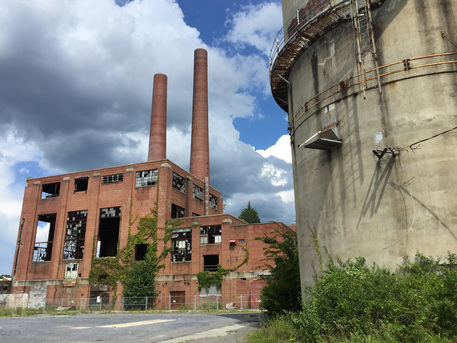 When Industry Moves Away Only Rubble Remains When Industry Moves Away Only Rubble Remains In far too many places in this state, and throughout The South, there's an empty factory. A place that may have paid a decent wage, maybe build the makings of a community, provided a good product to customers. But now it's barren. It might be an empty shell of a building. Might be an empty lot that isn't fit for much. It might be a contaminated brownfield that no one even wants to walk across. This is not a post to demonize individual businesses. It's to make a point. Businesses, especially big ones, come and go. They sprawl out across the soil and do well among us. Until some other town offers them a tax deferral or some new treaty makes relocating to another country profitable. But Agriculture was our top industry in 1735. And the occupants of what is now Georgia were raising the "three sisters" - corn, squash, and beans - a thousand years ago.
We have soil, water, air, and sunshine. If every heavy industry in this state closed tomorrow, one in seven Georgians would never miss a day of work. Polluted air, water, and soil could end up costing us over $74 billion a year. We need to consider our economy. I know we need commerce and industry. Agriculture alone is not the answer. But we also need to remember which side our bread is buttered on and protect the resources that our economic engine needs. In the coming weeks, there will likely be a few more environmental posts. There's an announcement coming soon about that. Until next time... 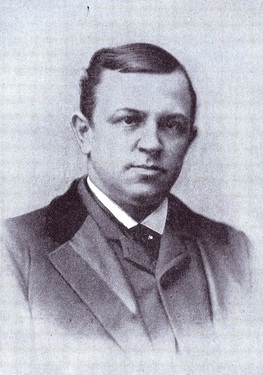 Henry Grady, "The Voice of the New South" Henry Grady, "The Voice of the New South" ABG is not specifically a news site. What we do is commentary. But much of what we publish is either inspired by or in response to stories from the news. This week, I had my eyes opened about one vital source of news. This awakening came from a most unlikely source.
On my Twitter feed I encountered this video from Last Week Tonight. This is not a typical source for ABG and the video gets a bit seedy at times but the video details the importance of newspapers in America today. It's fair to say that newspapers are struggling today and it's easy to dismiss print media as a relic of the past. But just as John Oliver says in the clip, these journalists are the front line in holding our elected officials accountable for the effective and ethical execution of their offices. Then this article appeared in the Rome News-Tribune in which Severo Avila details the need for consumers of news to hold their sources accountable for content that is honest, serious, and reputable. He encourages people to check up on reports they find on the internet and determine if a source is a true news source or just a biased propaganda machine. Georgia has a storied history with newspapers. Probably the best known is Henry Grady who began his career as a writer for the Rome Courier before its bankruptcy. Grady went on to become the editor of The Atlanta Constitution, the "Spokesman of the New South", and even the namesake of Grady Hospital. Governor Hoke Smith owned The Atlanta Journal. Margaret Mitchell wrote for the Journal from 1922-1926. Joel Chandler Harris worked as a writer for Grady's Constitution. Ralph McGill was a voice for the Civil Rights movement during his tenure as editor of the Constitution. We have to mention the legendary work of Lewis Grizzard at the Constitution. And I've found a Georgia hero in Bo Whaley, whose writing graced the Dublin Courier-Herald. That mostly sounds like a treatise on the history of The AJC but those are the names we recognize statewide. Keeping in mind that we discuss the idea of decentralization a lot here, I don't know why it never occurred to me that we need to decentralize our news sources. The national news is never going to give you a full story on topics that are pertinent to your hometown, especially if you aren't in the metro areas. The top-of-the-hour news blurbs on your local radio stations aren't going to cut it either. If we are going to have strong sources for local news we are going to have to support the Macon Telegraph, The Savannah Morning News, The (Milledgeville) Union-Recorder, The Rome News-Tribune, The Pickens Progress, etc. We have to expect these outlets to cover local crime and politics as well as reporting on local "feel good" stories. And we need to hold them accountable for being honest and telling us the truth. Besides, the papers are staffed with people who are passionate about our community or people getting started in the business. Henry Grady started in Rome at a paper that filed bankruptcy. He ended with a statue in Downtown Atlanta, a hospital and a high school named for him, and also being known as one of the most important voices in Georgia and The South. This very site can trace its roots to a classroom in a now defunct high school where a handful of diverse teenagers produced a student paper of which, to this day, I am proud to have been a part. Newspapers aren't dead yet. And if we are to survive as an informed and engaged populace we really need to support them. So add newspapers to the list of local institutions that we support and recommend. |

Sam B.Historian, self-proclaimed gentleman, agrarian-at-heart, & curator extraordinaire 
ABG Sponsor, Click Here
ABG Sponsor, Click Here
ABG Sponsor - Click for Link
Social Media
Categories
All
Archives
November 2022
|
 RSS Feed